Tuck End Box Styles Explained: Straight Tuck vs Reverse Tuck vs Auto-Lock Bottom
When choosing your end box, it's not just about finding the style that fits the screen best. The closure is the way that the carton opens up, the packing speed of your staff, the quality of your carton base, the amount of print on your carton, and the packaging cost of your retail product for cosmetics, supplements, candles, electronics, and more.
There are four styles that are most frequently mentioned: straight tuck end, reverse tuck end, auto-lock bottom, and snap-lock bottom. Premium Custom Shipping Boxes can produce custom tuck packaging in these types and can replicate the structure to the size, material, printing and packing requirements of your product.
Style | Packing speed | Relative cost | Best suited for |
Straight tuck end | Fast | Lower | Retail products, cosmetics, windows, front-facing graphics |
Reverse tuck end | Fast | Often lower | Cosmetics, pharma-style cartons, retail products |
Auto-locked bottom | Fastest | Higher | Faster fulfillment and heavier retail products |
Snap-lock bottom | Moderate | Lower than auto-lock | Products needing a secure base without pre-gluing |
According to PCSB's own style guidelines, straight tuck is a popular quick-assembly mailer style, and auto-bottom is the fastest assembly style. It is also available in reverse tuck and snap-lock box for the tuck-box range.
What is a Tuck End Box? What Is a Tuck Box?
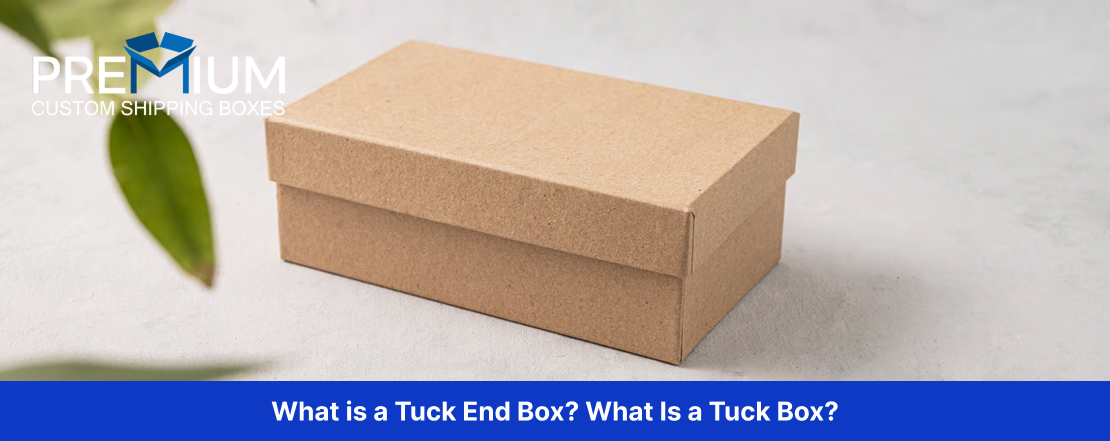
A tuck end box is a folding carton with tuck flaps to close the top, bottom or both ends of the carton. This family of folding carton styles are generally provided flat, then folded into shape, and is useful for retail packaging, ecommerce fulfillment or where strong branded sides are needed, but a box is not required.
The term tuck box is very general. It can refer to a straight tuck end box, reverse tuck end box, tuck top box, auto-lock bottom box or others. These types of structures make up PCSB's existing tuck-box classification.
A typical tuck carton has the following structural parts:
Part | Purpose |
Main panels | Create the front, back, and sides of the carton |
Tuck flap | Folds into the carton to close an end |
Dust flaps | Help close the sides and limit openings at the ends |
Glue flap | Attach to the carton body in the manufacturing process |
Bottom closure | Provides the base structure and determines how the product is loaded |
Window panel | Optional die-cut area for product visibility |
That construction brings a significant packaging appearance/packaging performance balance for brands. A cosmetics company with a clean front panel and a window may be more concerned about a clean front panel and window, while a supplement company that is shipping thousands of units through a fulfillment operation may be more concerned about packing speed.
For tuck packaging, PCSB provides custom dimensions, choice of paperboard material and corrugated, custom printing, finishes and windows, and other structural elements.
Straight Tuck End vs Reverse Tuck End: Which Tuck Box is Best?
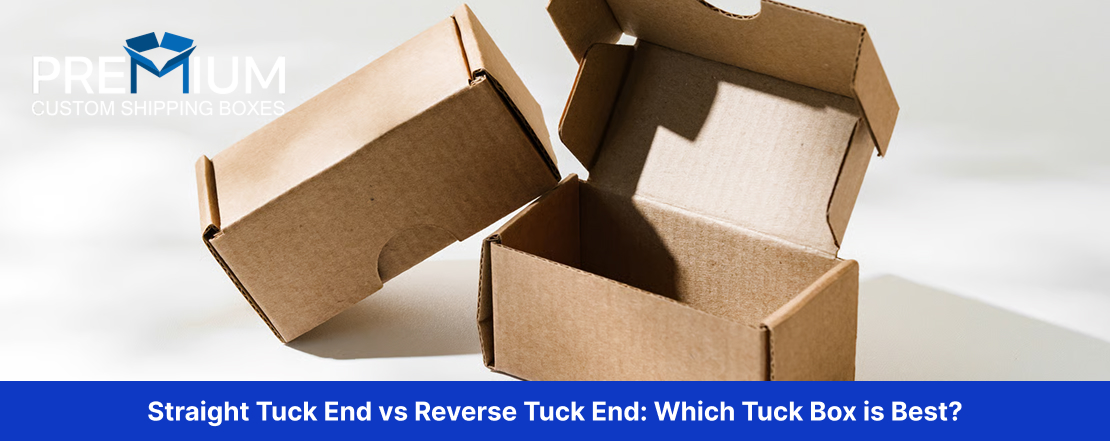
A straight tuck end box isn't the same as a reverse tuck end box; in the first the tuck flaps are set to close in the same direction, and in the latter, in opposite directions. They both are carton folding styles that are suitable to the product, but their panel arrangement, printing preferences, die layout, and opening experience can make one a better fit for a specific product.
Straight Tuck End Box
The front is clean and consistent with a straight tuck end box, as the tuck closures are all facing the same way. This is especially appealing when the front end of the carton is a key element in the product presentation.
The front panel may have the product name, product benefits, brand identity, regulatory information, and an optional die-cut window may display the product. Straight tuck end, PCSB says, is "a popular style for fast assembly and retail presentation. It also offers custom windows, finishes and printing packages.
Best fit: cosmetic products, skin care products, candles, accessories, small retail products and products with front panel graphics.
Box End Tuck Back
An end box that is tucked in the opposite direction from the bottom has a reverse tuck end box. This alters the dieline and panel layout of the carton, but still provides a simple folding carton.
In retail and pharmaceutical-type packaging, reverse tuck end boxes are very common due to the ability of the opposing closures to be effective in the carton layout. Reverse tuck end is one of the major tuck packaging formats used by PCSB and can be used in a variety of industries, such as pharmaceuticals and electronics.
Why Reverse Tuck Is Often Cheaper to Print
When possible, the dieline for reverse tuck can be more economical in production when cartons can be efficiently nested on the printing sheet. Can be used to increase the use of materials and yield fewer wastes, but the exact price quoted will vary according to carton size, board, carton quantities, print process, finishing, and the manufacturer's production set-up.
That is why it is not appropriate to evaluate only by the construction name for the use of reverse tuck end box pricing. Get the full quote with your full size and number.
Consideration | Straight tuck end | Reverse tuck end |
Front presentation | Excellent | Excellent |
Closure direction | Same direction | Opposite directions |
Window suitability | Excellent for many layouts | Possible, depending on dieline |
Retail use | Very common | Very common |
Graphic layout | Clean front panel | Efficient overall layout |
Potential production economy | Good | Can be very good if nesting is efficient |
Best decision variable | Presentation and window | Dieline efficiency and overall cost |
When considering custom straight tuck end boxes versus reverse tuck packaging, request the packaging manufacturer to create the dieline beforehand. The physical size of the product may vary, and thus the structure that works best with board will vary.
What is an Auto-Lock Bottom Box and When is It Required?
The auto-lock bottom box, or crash-lock bottom, is a box with a pre-glued bottom which locks automatically when the flat carton is opened. Suited for businesses that would like a bottom closure that is easier to use than multiple interlocking flaps, which must be folded manually.
This can make an important difference for brands packing large order volumes. When the unit price of a carton is not as significant as the number of handling steps that can be saved by employees/fulfillment partners who are repeatedly opening flat cartons and preparing them for products, this value may be more significant.
Consider auto-lock when product requires a more substantial bottom structure. There is no fixed weight of the product to determine if it will have an auto-lock bottom. The type of material, board thickness, dimensions, construction and loading should be decided on the actual product.
PCSB can work up a product to determine the dimensions required for the container, as well as the carton structure and material for a heavier candle, container, electronics accessory, or retail product. It now offers tuck packaging in paperboard and corrugated for various uses.
When is it appropriate to use auto-lock?
Choose an auto-lock bottom when:
Your team is packing a lot of products
One of the critical operating costs is the speed of assembly
You'd like a pre-glued base
Product features a heavier bottom
You want to reduce manual bottom-folding steps
The problem is that an auto-lock structure may be more expensive than a more basic tuck or snap-lock structure. This premium should be considered in terms of carton cost, packer labour costs, order size and product specifications.
What Is a Snap-Lock Bottom Box and What Is the Difference Between Auto-Lock and Snap-Lock?
The snap-lock bottom box (also referred to as a 1-2-3 bottom) is made by snapping together interlocking bottom panels. The bottom of the Auto-Lock is already glued on, making it simpler to assemble in most cases.
Both of the two structures can give a secure bottom, but they are able to solve different production problems. According to PCSB, snap-lock cartons are those that have interlocking panels, while auto-lock cartons are pre-glued bases that self-lock when they are being set up.
Variable | Auto-lock bottom | Snap-lock bottom |
Bottom construction | Pre-glued | Interlocking flaps |
Setup | Very fast | More manual |
Glue applied before packing | Yes | No pre-glued base required |
Relative carton cost | Higher | Lower |
Packing labor | Lower | Higher |
Best for | High-volume packing | Cost-conscious operations |
Bottom security | Strong | Strong when correctly assembled |
This is quite easy for many brands to make. When the carton is more expensive, but the operation is very labor-intensive, auto-lock bottom box packaging may offer more overall value. When considering carton cost and packing labor is low, a snap-lock bottom box might be more appropriate.
The correct answer is to be tested on a real sample of the product, not from the image of the product provided.
Other Tuck Box Styles: Tuck Top, Roll End and Double Wall Tuck Top
There are other types of tuck packaging besides straight and reverse tucks. Different presentation, protection, and opening needs can be solved by tuck top boxes, end tuck top structures, and double wall tuck top boxes.
PCSB currently supports tuck top, roll end tuck top, kraft tuck packaging and double wall tuck top. When the event of the opening is at the top, and the product requires a simple retail closure, a tuck top box is useful. A roll end tuck top is a roll body with a tuck closure and may offer a more weighty, good look. Additional board structure and reinforcement are also desired where a tuck top with a double wall has two folds of board.
Style | Primary advantage | Typical consideration |
Tuck top | Simple top opening presentation | Product dimensions and closure fit |
Roll end tuck top | More substantial structure | Dieline and manufacturing requirements |
Double wall tuck top | Added structural support | More material and construction |
Straight tuck | Clean front presentation | Ideal when graphics and windows matter |
Reverse tuck | Efficient opposing closures | Dieline efficiency and opening direction |
What is crucial to note is that folding carton styles can't be interchanged. The structure will differ depending on the product, the way the product is packed, the way the product will be displayed and whether it is likely to be used as a package during shipping or as a retail package.
Which Tuck Style to Use for Your Product?
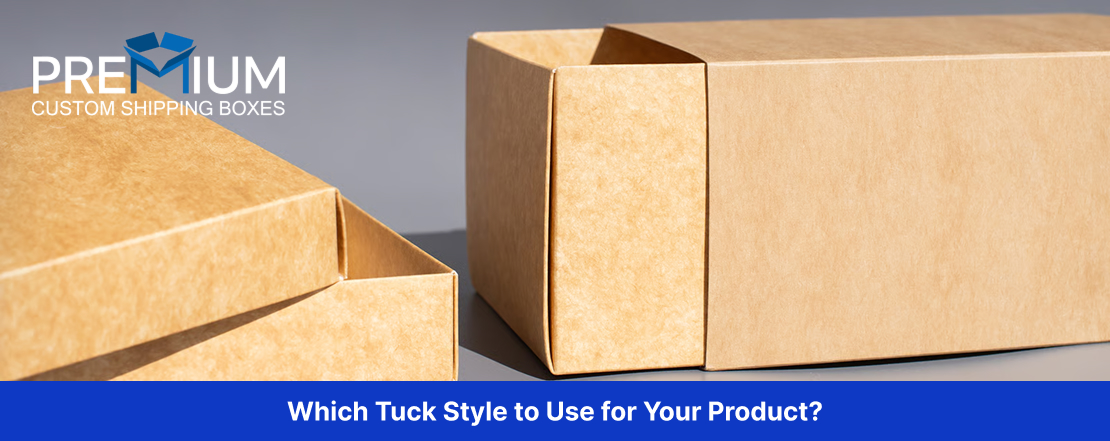
There are five factors that determine the best tuck end box: product weight, packing method, window requirements, graphics priority, and budget. In most cases, it's best to work the carton to fit the production process, not necessarily the look.
Product or business requirement | Recommended starting style | Why |
Premium cosmetics with front graphics | Straight tuck end | Clean front-facing presentation |
Cosmetics for a product window | Straight tuck end | Convenient construction for a front window product window layout |
Increased order volume | Automatic locking at the bottom | Quick installation |
Cost-conscious retail carton | Reverse tuck end | Can offer efficient sheet utilization |
High-volume manual fulfillment | Auto-lock bottom | Fast setup |
Heavier retail product | Auto-lock or reinforced structure | More substantial bottom construction |
Lower-cost secure bottom | Snap-lock bottom | Interlocking base without pre-gluing |
Product requiring substantial presentation | Roll end tuck top | More structured appearance |
When a window is included in a tuck end box, tuck end straight is often a good place to begin since the front-facing panel offers a natural place for a die-cut viewing area. PCSB offers die-cut window panels as an add-on structural feature, so the final suitability should be checked against the actual dieline and product position.
Which Tuck Style is Cheapest?
No one box is always the cheapest tuck end box, as the price of the carton will depend on the size, material, quantity, printing, finishes and the efficiency with which the dieline has been created. While auto-lock is typically a more cost-effective structure, a simple tuck structure or reverse tuck may be a better option in many projects due to pre-gluing and additional manufacturing costs.
What Kind of Tucks are Used for Heavy Products?
When dealing with heavier products, consider using an auto-lock bottom box or any other enhanced construction, rather than going with a straight/straight receptacle simply because it is less expensive. PCSB also mentions that the auto-bottom styles work well for heavier items, and material selection is also significant for structural strength.
A corrugated structure might be more suitable than a traditional folding carton for shipment-intensive or heavier products. For applications that call for extra structure, PCSB stocks e-flute and b-flute corrugated stock.
Which Style is Suitable for a Window?
A straight tuck end box may be a good option for a window, since the front panel provides a clear space for product visibility. But windows can be added in various carton structures where the dieline, product location and construction of the board will permit.
PCSB can provide custom die-cut window panels and PET or other window types as needed for packaging applications.
If the window is the focal point of your product presentation, request a dieline and physical sample prior to approving the production. This allows you to check for the correct part to be seen through the window while not blocking the tuck flap, dust flaps, graphics, and/or structural folds.
How to Order the Right Custom Tuck End Box
When you get started with a product, instead of the box name, it becomes a lot easier to choose the right tuck end box. Provide the packaging manufacturer with the finished length, width and height, approximate weight, packing method, market, order quantity and requirement of window or special finish.
PCSB's existing ordering process requires customers to give dimensions, quantity and preferences for materials before the structure and layout are determined. It also has a tuck-box process with die-line, digital proof, and 3D mock-up review prior to production.
They offer a complete selection of tuck end boxes and other box styles for you to check out prior to obtaining a quote. The tuck-box range includes straight tuck end, reverse tuck end, auto-lock, snap-lock, tuck top, roll end tuck top, kraft tuck packaging and double wall tuck top structures.
PCSB can provide custom printing and finishing options such as CMYK, digital and offset printing, PMS colour matching, matte and gloss lamination, soft touch, spot UV, foiled stamping, embossing, debossing, and aqueous coating.
In the packager selection phase, when brands are still weighing their options with regard to custom straight tuck end boxes, reverse tuck packaging, or an auto-lock or snap-lock bottom, this is when a packaging supplier can truly make a difference. It's not just about making the box you requested. Its purpose is to ensure that the selected structure is compatible with the product, packing process, brand presentation and budget.
Conclusion
The right tuck end box is not only for your packaging brief, but it's also for your product and your operation. Straight tuck is probably the most effective basic presentation for clean windows and retail; reverse tuck can be desirable when dieline efficiency and cost are important considerations; and auto-lock and snap-lock bottoms are more likely to be considered when the bottom strength or the packing workflow is the driving force.
Premium Custom Shipping Boxes collaborates with US brands to offer customized tuck packaging, such as structure choice, material selection, custom size, printing, finishes, windows, proofing and manufacturing. The present tuck packaging line is suitable for well-established retail and DTC brands in various product categories including cosmetics, food, electronics, personal care and apparel.
If you already have product dimensions, quantity and material of choice, contact Premium Custom Shipping Boxes for a custom packaging quote. While you're still making your choice between a straight tuck end box, reverse tuck end box, auto-lock bottom box or snap-lock bottom box, be sure to include the weight of your product and packing method in the quote request; then the PCSB team can make a recommendation about the structure.
Frequently Asked Questions
What is a tuck box?
A tuck box is a folded carton with tuck flaps to close one or more ends. Common types include straight tucks, reverse tucks, tuck top, auto-lock, and snap-lock.
What is the difference between a straight tuck end box and a reverse tuck end box?
At a straight tuck end, the top and bottom closures travel in the same direction. Reverse tuck end - Alternate directions of closing. These differences have an impact on the dieline, opening experience, graphics, and in some cases, production efficiency.
What do you mean by an Auto-lock bottom box?
An auto-lock bottom box comes with a pre-glued bottom that locks into place when the carton is opened. This is very helpful when carton setup time is critical for operations.
What does snap-lock bottom box mean?
Snap Lock Bottom Box (also called 1-2-3 bottom) is a bottom box that has flaps that interlock together. Can offer a secure base without the need to pre-glue an auto-lock carton.
Which tuck box would be the most affordable?
There is no universal cheapest option; however, a simple tuck construction or reverse tuck may be the more economical starting point than an auto-lock construction. The final quote will depend on dimensions, board, quantity, printing, finishing and dieline efficiency.
Is it acceptable to make cosmetic tuck end boxes?
Yes. The PCSB provides a specific description of cosmetics and beauty as one of the industries that is utilising custom tuck packaging. When branding and visibility of the product on the front are significant, straight tuck end cartons can be very beneficial.
Are windows allowed in tuck boxes?
Yes. Custom die-cut windows can be used in an appropriate carton structure. The location of the window needs to be designed to support the product, structural flaps, graphics and dieline.
Which box would you use to get a heavy product from?
Use an auto-lock bottom or other reinforced construction for heavier items; choose the material and board construction to the actual weight and load distribution of the product. If heavy shipping loads are required, corrugated construction might be better suited.
May I see some samples before I place an order for a large quantity?
PCSB says its tuck-box workflow features a digital proof and white mock-up sample prior to production.
What are the differences between tuck box styles?
Begin by measuring the product and weighing it; then determine packing time, windowing requirements, graphics, storage considerations, shipping conditions, and budget. When in doubt, ask the manufacturer to compare two or three structures with the same specifications.