How to Vet a Corrugated Box Manufacturer: 9 Questions to Ask Before You Order
If you are new to purchasing corrugated packaging, locating a corrugated box manufacturer is only part of the battle. The more difficult part is assessing whether that manufacturer can provide the board, construction, print quality, time, and commercial terms required by your business.
The following nine questions should be asked of every corrugated box manufacturer, supplier, broker, or distributor that you consider for your business. Getting the right answers to these questions will give you the information necessary to make an informed decision when selecting a corrugated box manufacturer for your business.
Are you a manufacturer, broker, or distributor, and where is your plant?
What is your MOQ, and how does price change with quantity?
When does your lead time start?
Who pays for the die and who owns it?
What proof and samples will I receive?
What board specifications are you quoting?
What print methods and color limitations apply?
What certifications can you provide?
What are your terms for freight and payment?
How Do You Choose a Corrugated Box Manufacturer?
You should compare production locations, specifications, proofs, lead times, tooling, quality documentation, freight, payment terms, and price to get the full picture. The best suppliers will be able to explain their quote and show you supporting documentation.
The first step should be making a comparison matrix. Put each supplier in a column and your questions in rows. This helps you make an apples-to-apples comparison. Lowballing a quote can sometimes cover higher freight costs, weaker board specifications, longer approval cycles and tooling costs.
Ecommerce brands need to think about how boxes will be transported and handled after they leave the plant. Boxes are susceptible to forces like compression and vibration, as well as sudden shock and impact from drops. Boxes are also subject to different types of environmental conditions, such as moisture, during transport and handling.
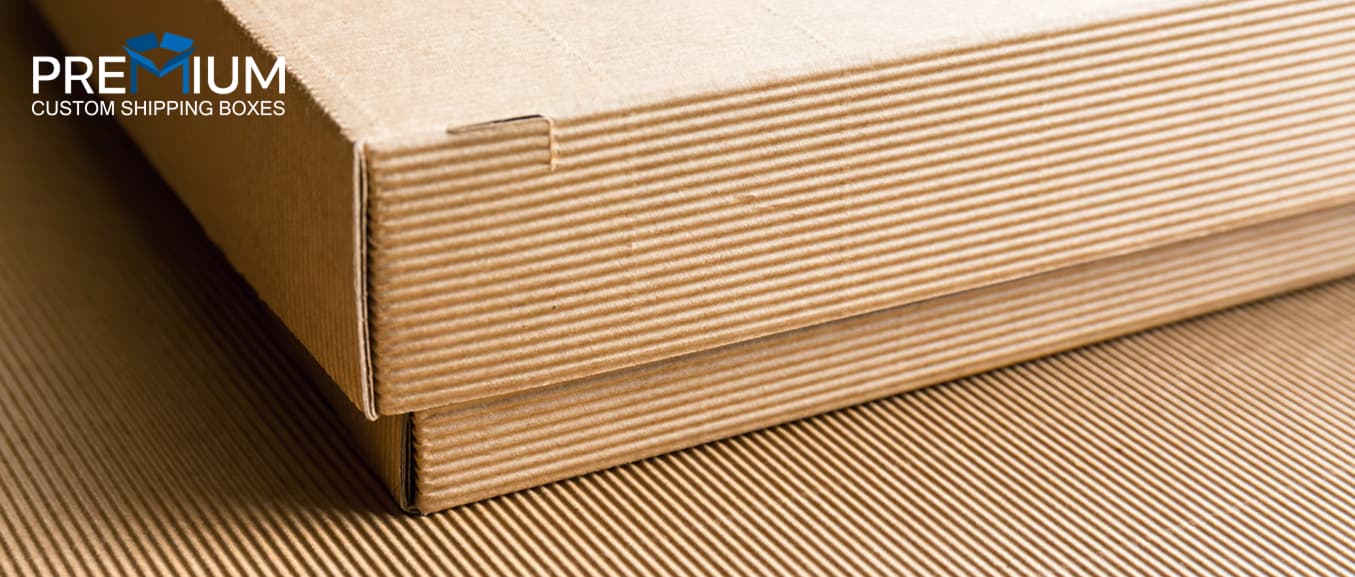
The Fibre Box Association states that corrugated fiberboard is constructed from linerboard and fluted medium. The profile of the flutes affects cushioning and compression strength as well as other performance characteristics; therefore, specifying “heavy-duty cardboard” is not sufficient.
If you are interested in a supplier to take you from designing the boxes through to production and shipping, start with Premium Custom Shipping Boxes and use the same evaluation criteria below to assess their custom shipping boxes.
Manufacturer, Broker or Distributor: Know Who You Are Buying From
A corrugated box manufacturer generally performs both the converting and the packaging; a broker, on the other hand, arranges the packaging through another company, and a distributor generally buys and resells the packaging. It depends on your situation what the correct answer is, but it is good practice to always know who is producing the packaging.
Ask: "Where is the plant producing my order and who is responsible for quality?"
Premium Custom Shipping Boxes says it manufactures its packaging in US facilities. Its published process covers consultation, specification, prototyping, manufacturing, and delivery. This creates verifiables for a customer. These include where production takes place, what is manufactured in-house, and which processes are outsourced.
Minimum Order Quantity and Price Breaks for Corrugated Box MOQ
MOQ for corrugated boxes is the lowest quantity a supplier will make a particular box. A good answer includes the MOQ for your exact structure and print specification and the prices at quantity breaks.
When evaluating a potential supplier, do not simply ask, "What is your MOQ?" Find out at what quantities you would realistically buy and ask for the price at those levels.
Level of Quantity | Questions to Supplier |
Test run/sample | What is the MOQ and what are the setup charges? |
First production order | What is the unit price and what is the total delivered cost? |
Mid-volume order | What is the price per box and what is the savings? |
Larger order | What is the volume price and what are the terms of the order? |
Multiple SKUs | Whether MOQ applies separately to each SKU |
There is no single universal MOQ for all corrugated boxes. Structure, dimensions, board type, printing process, tooling and equipment can all vary the economics.
Currently, Premium Custom Shipping Boxes allows shipping box quantities to be flexible. The company website states that for plain, unprinted boxes, the minimum order quantity (MOQ) is 25, while custom printed boxes have an MOQ of 50-100, and MOQs of 1,000 or more are considered a high-volume order, and significant discounts may apply.
When doing your comparative analysis, make sure you request the same quantity from all suppliers. Otherwise, a quote at 1,000 boxes cannot be fairly compared with a quote at 5,000 boxes.
Packaging Supplier Lead Time: When Does the Clock Start?
A packaging supplier lead time should state the day production starts and shipping is completed separately. A good lead time gives you the details of artwork approval, proof approval, production, and shipping. Instead of a vague, lumped-together delivery date, you should be given distinct details of the various steps of the process. Use this when doing your comparative analysis:
"What is your lead time from final proof approval to completion of production and shipment to our location?"
According to PCSB’s published information, most regular, custom printed orders take 7 to 10 business days to ship after digital proof approval and final order placement. Large-volume orders, which may require custom tooling, can take 14 or more business days. Rush orders are also available.
You should verify the number of business days the following process steps require:
Artwork review
Proof approval
Production
Tooling
Freight
Total expected time
Box Tooling Cost: Who Pays and Who Owns the Die?
A die is a cutting tool used to cut and crease board into the shape of a box. For custom die cutting, who pays for the cutting die? Is it included in the quotation? How long is the die usable? Who owns the die?
The essential question is not “Is there a tooling charge?” It should be:
“If I pay for the die, do I own it and can I use it if I move production later?”
A supplier should be able to put the answer in writing. Tooling may also relate to the quantity ordered. For a low-volume order, tooling may be a high effective per-box cost, but for a high-volume order, tooling would be spread over many boxes.
PCSB publicly states that large-volume shipping-box orders that require custom tooling may have longer production times. Just because you pay a tooling fee doesn’t mean you own the physical die.
Proofs and Samples
Ask whether you can have a digital proof, physical mockup, and/or sample before the run, and whether a plain sample of the structure can be inspected prior to the full run.
A good answer describes what is approved and what happens after approval. There are several things a supplier can call a sample.
Sample Type | Verifies |
Physical Sample | Artwork and copy placement, color, texture, fold lines |
Digital Proof | Artwork, copy, and color placement |
3D Mockup | Overall box and inserts appearance |
Plain Sample | Overall fit and assembly |
Printed Sample | Overall box and inserts appearance and construction |
PCSB states that it helps create dielines and print approvals, uses AI and PDF files, and provides sample support. Its published pages also state that sample requests for some of its packaging are fulfilled.
For ecommerce brands, a plain sample can help you check the actual product inside hundreds or thousands of boxes before final approval.
Board Specification: What You Should Be Quoted
Because corrugated board is made of different liners and mediums, quotations need to describe the board construction, flute, and strength to properly assess the board specification. Wall, flute, and strength should be assessed for each layer of the board to determine the overall board specification.
For shipping, ask your contact for the ECT or the burst specification, and verify it with your product and distribution requirements. Ask your contact for these variables.
Board Variable | Example Question |
Wall | Is this single-wall or double-wall? |
Flute | What size flute? |
Strength | What ECT or Burst specification? |
Dimensions | Are these outside or inside dimensions? |
Material | What liner and medium grades? |
Testing | What test reports are available? |
The Fibre Box Association states that Edge Crush Test (E.C.T.) can be used to evaluate strength of corrugated board if the test is conducted with finished boxes to determine stacking strength.
Premium Custom Shipping Boxes (PCSB) public corrugated information provides single-wall, double-wall and heavier-duty corrugated board structures and describes ECT-rated materials as part of its product offering.
To explain board construction, have your company's purchasing team complete the What Is a Corrugated Box? presentation before asking your contact to finalize the specification.
Print Method and Color Limits
The print method affects cost, turnaround time, and quality. Ask which print method will be used for your quantity and artwork. Knowing how many colors are available per print run will also help you with your planning. Ask if printing is done inside or outside the facility. Knowing if there are setup or plate charges is also important. A good corrugated carton box manufacturer will explain why a particular process fits the run rather than simply selling you the most expensive option.
Common methods include flexographic printing, digital printing, and litho-based methods. Flexographic printing is ideal for the rapid repeat print runs that are typical of corrugated packaging and common in high-volume shipments. For more variable graphics, or for smaller print runs, digital printing may be a better alternative. The Flexographic Technical Association reports that digital printing is expanding the packaging industry’s ability to handle smaller runs, and lithographic and flexographic processes are likely to continue to be important for some years.
PCSB currently offers flexographic, digital, premium offset, and screen printing. Its printing guidance states digital printing is better for smaller runs, and that for bigger runs, flexographic and offset printing are more cost-effective.
Certifications Worth Asking For From Corrugated Box Companies
Certifications should be commensurate with risk. Ask the supplier to identify the precise certification, certificate holder, scope, expiration and the certification body rather than accepting a logo on the web as evidence.
Certification/Documentation | What it covers | What to request |
FSC Chain of Custody | Forest-based materials and their tracking through the supply chain | Certificate number and scope |
ISO 9001 | Quality management systems | Most recent certificate and scope |
BRCGS Packaging Materials | Safety, legal and authenticity assurance for packaging operations | Current site certificate |
FDA Food Contact | Legal status of FDA-regulated food contact substances & their uses | Appropriate documentation for the intended use |
ISTA | Evaluation & testing of the packaged product system on ISTA criteria | Test report, ISTA guidelines, and applicable procedures |
FSC Chain of Custody certification helps trace forest-based materials through manufacturing and distribution. FSC describes certification as independent assessment and annual audit.
ISO 9001 is a quality management system standard. Latest 2026 edition of ISO defines requirements for establishment, maintenance and continual improvement of the quality management system.
BRCGS Packaging Materials is focused on packaging operations and helps ensure quality assurance, legal compliance and authenticity. BRCGS states that certification is done through a registered certification body.
FDA Food Contact regulates food contact substances and their allowed uses. The relevant documents are based on the material and the intended conditions of use.
ISTA requires special attention because ISTA does not certify box material in a generic sense. ISTA’s Transit-Tested program focuses on a packaged product system. Certification is done after testing and review are completed based on the conditions of ISTA program.
This is important for ecommerce products because parcel distribution can make packaging take a greater beating and because of the Amazon
Ships in Own Container program.
Amazon's packaging instructions consider SIOC as a requirement related to the packaged product, as opposed to a generic box certification, freight and market conditions.
The company's materials state that their boxes can be made with materials sourced from FSC-certified suppliers. This should not be read to mean PCSB is FSC certified. Ask for relevant documentation for your order.
Freight and Payment Terms
Freight should be assessed as part of the box cost. Ask if freight is included in the quote, where the box is shipped from, what service level is assumed and if liftgate, residential, pallet or access charges are included.
For bulky corrugated boxes, the delivered price can be substantially higher than the quoted price.
Commercial Variable | Question for the Supplier |
Freight | Is shipping included in the price? |
Origin | Where does the shipment leave the plant? |
Destination | Is the quote for my exact location? |
Palletization | How many boxes per pallet? |
Accessorials | Could a lift gate or residential service be needed? |
Payment | Is there a deposit? Is credit available? |
Repeat Orders | Is payment before production required? |
Quotes are valid for a certain time period. Printing costs change based on volumes and board and printed method. Each run of the press has tooling and set up costs that are baked into the price. Freight and local conditions all impact cost.
So how much do corrugated boxes cost? The best way to get an accurate number is to request a delivered price for a specified quantity and specification. Comparing random costs of boxes with no specs or considering tooling, freight, or other factors is meaningless.
Red Flags in a Corrugated Box Supplier's Answers
The biggest warning signs are delivery lead times that are not specified. Make sure the supplier can easily be audited. They should be able to provide whatever info is needed to do an audit. If quotes are difficult to audit, they probably have something to hide.
Red Flag | Why it Matters |
“Heavy-duty corrugated” with no ECT or burst specification | You cannot compare board strength |
“Two weeks” with no starting point | Proofing and production may be excluded |
“Tooling is included” with no ownership terms | You may not know who controls the die |
One price with no quantity break | You cannot evaluate volume economics |
Certification logo without certificate details | Claim cannot be independently verified |
Freight added after approval | Your actual landed cost may be materially different |
Supplier will not identify production source | You may not know who is accountable |
These are not proof that a supplier is unreliable. They are warning signs to ask a more specific question before money is spent.
A professional purchasing process will have details of approved proofs, tooling, price, lead time, payment terms, and freight arrangements.
A Note for Texas Buyers
Freight and proximity to your plants are part of the sourcing decision in Texas, especially for bulky or heavy corrugated orders. A supplier located nearer to your delivery plants can potentially reduce exposure to transit and freight costs and reduce the time the shipping package spends in transit, but this is dependent on a number of factors, including the size of the shipment, the rate of the carrier, the distance from the supply point to the delivery point, and the supply point location.
Conclusion
Factors such as cost, size, wall construction, flute, ECT or burst rating, quantity, print method, tooling, materials, freight and current containerboard costs can impact the decision of choosing a corrugated box manufacturer.
Other considerations can be annual or initial quantity, box style, board strength, print requirements, the ZIP code of the destination, the targeted delivery date, and any testing or certification requirements. The more board in the product, the higher the box cost.
Premium Custom Shipping Boxes and its team support the design and structuring of box, choice of material and artwork, among other things, in the box ordering process.
Frequently Asked Questions
What factors should I consider when choosing a corrugated box manufacturer?
You should consider the MOQ, location of production, quantity pricing, lead time, tooling ownership, proofing, board specification, printing, certifications, freight and terms of payment when choosing a corrugated box manufacturer.
What is a typical minimum order quantity for custom corrugated boxes?
In the corrugated box industry, there is no standard MOQ for all boxes. Generally, the less complicated the box structure, the lower the minimum order quantity.
How long does it take to make a custom corrugated box?
Lead time for a custom corrugated box is dependent on several factors including the box structure and quantity, printing, tooling, proofing, and the destination. As of this writing, Premium Custom Shipping Boxes says that after digital proof approval and for orders under 200 boxes, the lead time is 7 to 10 business days, and for orders over 200 boxes, the lead time is 14 business days. However, keep in mind that the lead time may vary from the time you are reading this. Check with them for an up-to-date lead time when you are requesting a quote.
What is a die and who owns the tooling?
A die is a specialized tool used to convert flat corrugated board into specific box shapes. Die owners may change their suppliers, but they should check if they own the die, if the die is stored by the manufacturer, and if they can get or send the die to a different manufacturer.
What is the difference between a manufacturer, supplier and distributor?
A manufacturer produces or converts boxes. A supplier is a company that provides packaging and may manufacture it directly or indirectly. A distributor stocks and resells the packaging. Typically, there is more than one supplier at a level and more than one manufacturer at a level. Ask who is accountable and who physically produces your order.